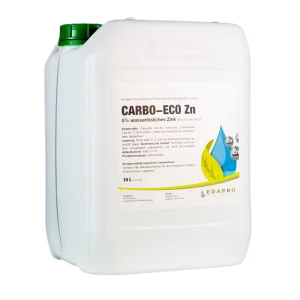
Magnesium leaf fertiliser Carbo-Eco-Mg 10 litres
CHF 91.35 incl. VAT
For professional users only. We’ll ask for your UID or farm number at checkout.
Magnesium fertiliser solution with 5% water-soluble magnesium oxide (MgO) and 10% water-soluble sulphuric anhydride (SO3). Corrects and prevents magnesium deficiency in all crops. Direct absorption and processing in the plant.
Registered as a farm input with the Research Institute of Organic Agriculture (FiBL) (expected to be listed from September 2023).
Contents: 10 litres
Mode of action and benefits
Magnesium foliar fertilisers are specifically developed for application to the leaves. Magnesium (Mg) is an important plant nutrient that is needed for various processes in plant metabolism. A deficiency of this nutrient can lead to various growth problems in plants, such as reduced growth, yellowing of the leaves and lower yields. Foliar application can quickly counteract an acute nutrient deficiency.
Chelated nutrients improve absorption and plant availability for optimal nutrient uptake.
The magnesium foliar fertiliser can be combined with other foliar fertilisers and compost tea. Why magnesium in cold spring soil doesn’t reach the plant despite full soil reserves is explained in our blog post Magnesium: why the deficiency comes in spring.
The chelation
A chelate is a chemical compound in which a metal ion is bound to a larger organic molecule, the chelating agent. This bond forms a complex that is both stable and soluble. The chelating agent usually forms multiple bonds with the metal ion, creating a ring-like structure. This unique structure of the chelate increases the stability and bioavailability of the metal ion and prevents it from precipitating or becoming inaccessible to plants or organisms.

Application and dosage
| Crop | Application rate |
|---|---|
| General | Foliar fertiliser for magnesium supply: 2-5 l/ha, concentration: 0.5-1%. Via irrigation: 0.5%. |
| Viticulture | Prevention of magnesium deficiency and stalk paralysis, leaf quality: Several applications with 5 l/ha from the time the shoots are visible until shortly before harvest. |
| Pome fruit | Against premature leaf fall, for magnesium supply: several times 5 l/ha from flowering (for varieties susceptible to russeting only from walnut size). |
| Strawberries | Yield, vitality, magnesium supply: 2-3 times 5 l/ha from the beginning of flowering until harvest. |
| Potatoes | Against premature leaf dieback, for better yield: 1-2 times 5 l/ha from the beginning of row closure. |
| Vegetables | 1-2 times 5 l/ha as soon as sufficient leaf mass has developed. |
| Stone fruit | Against premature leaf fall, for magnesium supply: 2-3 times 5 l/ha from the beginning of flowering until harvest. |
| Ornamentals | For leaf quality, leaf colour; photosynthesis, for magnesium supply: 1-2 times 5 l/ha as soon as sufficient leaf mass has developed. |
| Hops | 2-3 times 4 l/ha from the beginning of flower development until 4 weeks after the end of flowering. |
Magnesium: why the deficiency comes in spring even though the soil is full
Additional Information
| Weight | 11.9 kg |
|---|
Related products

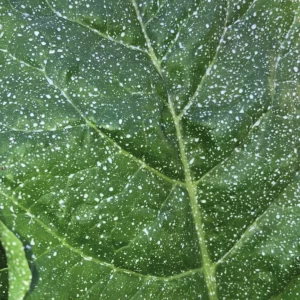
Kristallkalk sun protection – 25 kg
Kristallkalk keeps leaves cooler on hot days. The white film of fine lime crystals reflects part of the sunlight: in sugar beet, Bodenversum measured an average leaf temperature of 29.1 instead of 32.2 °C.
This does not slow down photosynthesis. On a hot summer day the leaf has more light than it can use; what holds it back is the heat. In every trial Bodenversum has shown us, the yield with Kristallkalk was above the untreated control.
Suitable for sugar beet, potatoes, cereals, vegetables, vines and fruit, and as a trunk coating. The needle-shaped crystals stick to the leaf better than ground limestone. Every application also brings calcium onto the leaf: 39 % Ca as calcium carbonate.
Apply with a crop sprayer: 6–10 kg/ha depending on water volume, 2–8 applications per season, no waiting period before harvest.
Contents: 25 kg bag
On request: pallet of 42 bags, 1050 kg


NK foliar fertiliser PhytoGreen Organic NK 4-6 10 litres
Nitrogen and potassium from sugar beet vinasse — 4 % N, of which 3.6 % is organically bound and of plant origin, plus 6 % water-soluble K2O.
Listed on the FiBL input list for organic farming in Switzerland.
The nitrogen comes as protein and amino acids, not as a salt. Soil microbes mineralise it, so it is released more slowly than from a mineral fertiliser. The C/N ratio of 6.5 is narrow enough to avoid nitrogen lock-up — and the 26 % organic carbon feeds the soil life at the same time.
Via irrigation at max. 5 %, via the leaf at 0.4–1.5 %. Foliar application can leave spray marks — so do not apply to russeting-prone pome fruit varieties or during flowering.
Content: 10 litres (13.0 kg)
200 litres CHF 347.85 and 1000 litres CHF 1’097.85 — not in stock, delivery on request

Organic Liquid Calcium 10 liters
Liquid calcium fertilizer, 8.0% CaO (water-soluble calcium oxide) for rapid uptake via the leaf. To improve assimilation performance, for higher yields: 4–8 l/ha or
2% w/v (2 l/100 l water) for foliar sprays.
The application of Bio NPK 2-1-10 can be combined with other foliar fertilizers and compost tea. (except sulfur and magnesium sulfate)
Listed as an input by the Research Institute of Organic Agriculture (FiBL).

PhytoGreen® – Organic NPK 2-1-10
Organic NPK fertilizer, liquid, with a high potassium content from purely plant-based raw materials. Through fermentation and enzymatic hydrolysis, a high-quality, potassium-focused complete fertilizer is created, which also provides water-soluble trace elements. Suitable for the fruiting phase of the crop.
The application of Organic NPK 2-1-10 can be combined with other foliar fertilizers and compost tea.
Listed as an operating material by the Research Institute of Organic Agriculture (FiBL).
Content: 10 liters
On request: 200 liters, 1000 liters
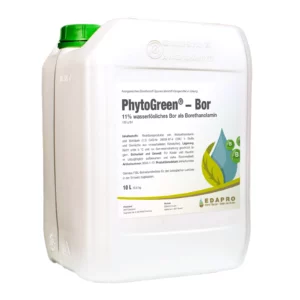

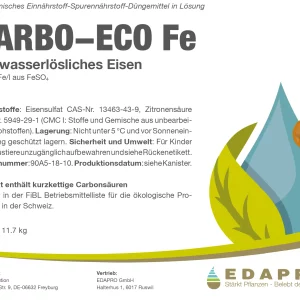
Iron Foliar Fertilizer Carbo-Eco-Fe 10 Liters
Iron fertilizer solution (from FeSO4) with 5% water-soluble iron (Fe). Corrects and prevents iron deficiency in all crops. Rapid absorption and processing within the plant. Corrects and prevents iron deficiency in all crops.
Listed as an input with the Research Institute of Organic Agriculture (FiBL).
Content: 10 liters