

Citric acid – 25 kg
CHF 107.75 incl. VAT
For professional users only. We’ll ask for your UID or farm number at checkout.
Citric acid lowers the pH of your spray water and dissolves limescale in drip irrigation lines. One 25 kg bag makes 37.5 litres of 50 % solution, as strong as liquid citric acid from the trade.
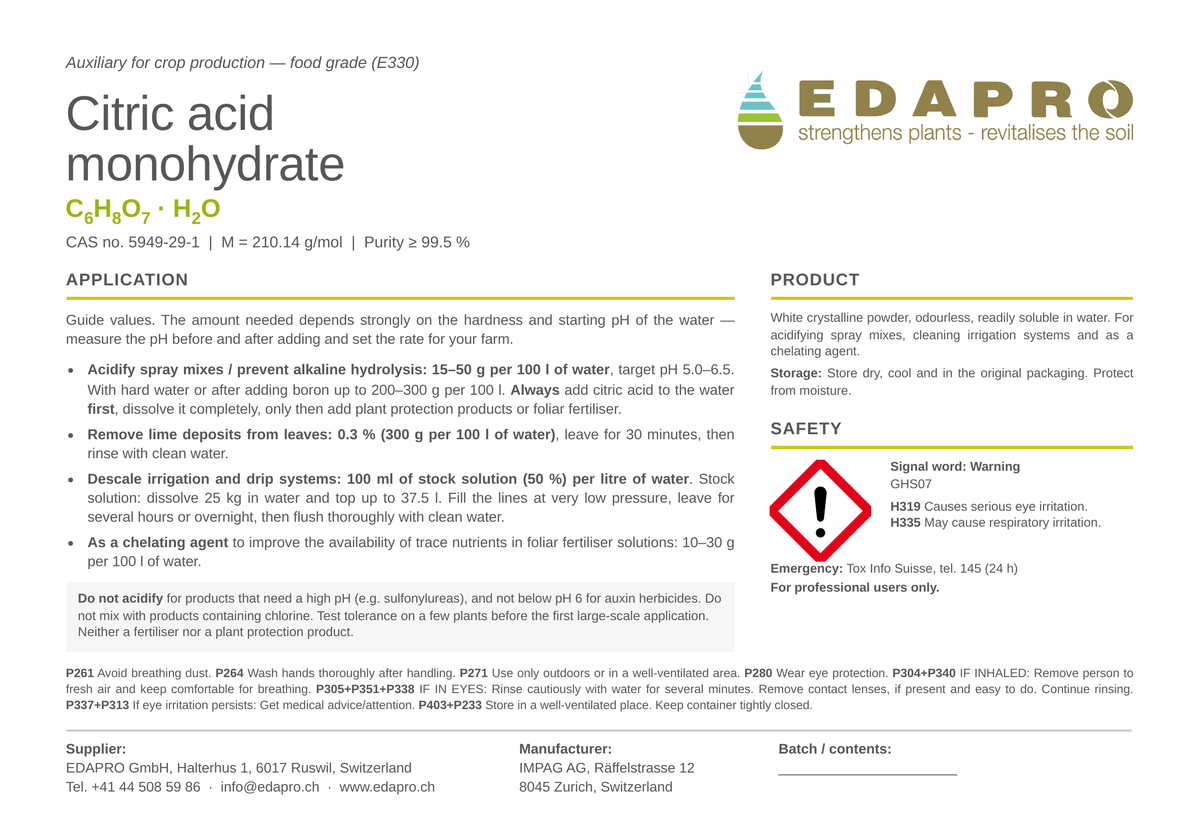
Citric acid monohydrate (E 330), food grade, purity at least 99.5 %. For acidifying spray mixes, descaling drip and irrigation systems, removing lime deposits from leaves and as a chelating agent in foliar fertiliser solutions.
Contents: 25 kg bag
What citric acid is
Citric acid is an organic acid that also occurs in citrus fruit. Ours comes from fermentation: the mould Aspergillus niger converts sugar into citric acid. The manufacturer then purifies the solution and crystallises the acid.
You get citric acid monohydrate in food grade (E 330): a white, odourless powder that dissolves easily in water. In crop production it is an auxiliary material, neither a fertiliser nor a plant protection product.
How it works
In water, citric acid releases hydrogen ions and so lowers the pH. It first uses up the bicarbonate that hard water carries. That is why water with a lot of lime needs more acid before the pH drops.
On limescale it works in two ways. The acid dissolves calcium carbonate, releasing carbon dioxide. Citrate binds calcium, magnesium and trace elements into soluble complexes (chelates). This keeps them in solution, so they can be flushed out.
Why citric acid
- One acid for four jobs: acidifying spray water, descaling drip lines, removing lime deposits from leaves and keeping trace elements in solution in foliar fertiliser mixes.
- Powder instead of canisters: 25 kg of powder make 37.5 litres of 50 % solution. The same amount of solution weighs about 46 kg.
- Easier to handle than mineral acids: sulphuric, nitric and phosphoric acid are corrosive at commercial strength (H314) and count as dangerous goods. Citric acid is classified as an eye irritant and travels as an ordinary parcel.
- Food grade: E 330, purity at least 99.5 %.
Application
The rates are guide values. How much acid you need depends on the hardness and starting pH of your water. Measure the pH before and after adding the acid and set the rate for your farm.
Stock solution: dissolve the 25 kg bag in water and top up to 37.5 litres. This gives a 50 % solution; one litre of it corresponds to about 670 g of powder. Keep it in a labelled plastic canister, never in drinks bottles. You can also add the powder directly to the water.
| Use | Rate | Notes |
|---|---|---|
| Acidify spray water, prevent alkaline hydrolysis | 15–50 g per 100 l water (22–75 ml stock solution); with hard water or boron in the mix up to 200–300 g (300–450 ml) | Target pH 5.0–6.5. Always add citric acid to the water first and dissolve it completely, then add plant protection products or foliar fertiliser. |
| Remove lime deposits from leaves | 0.3 %: 300 g per 100 l water (450 ml stock solution) | Leave for 30 minutes, then rinse with clean water. |
| Descale drip lines | 100 ml stock solution per litre of water, i.e. 10 l or about 6.7 kg citric acid per 100 l | Fill the lines, leave for a few hours up to overnight, flush thoroughly. Procedure below. |
| Keep trace elements in solution in foliar fertiliser mixes | 10–30 g per 100 l water (15–45 ml stock solution) | Dissolve the citric acid first, then add the foliar fertiliser. |
Descaling drip lines: how we do it
- Make the stock solution: dissolve 25 kg citric acid in water and top up to 37.5 litres (50 %).
- Dilute: 100 ml stock solution per litre of water, i.e. 10 litres per 100 litres. The finished solution has a pH of about 2.
- Estimate the amount: only mix as much as the lines hold. A 16 mm drip line holds 15 to 20 litres per 100 metres, depending on wall thickness. For 1000 metres, 9 to 12 kg of citric acid are enough.
- Fill with very low pressure: this keeps the solution in the line instead of running out through the emitters. Check at the last emitter with a pH strip that the acid has arrived.
- Let it work: a few hours, overnight if the scaling is heavy.
- Flush: open the line ends and flush thoroughly with clean water.
In winter we also blow the lines out with compressed air. Wear safety goggles when mixing, because citric acid irritates the eyes.
Where citric acid does not fit
- Do not acidify for products that need a high pH, for example sulfonylureas. Do not take auxin herbicides such as MCPA or 2,4-D below pH 6. When in doubt, follow the instructions for use of the product.
- Do not mix with products containing chlorine: acid releases chlorine gas from them.
- Before the first large-scale application, test tolerance on a few plants.
- Citric acid attacks base metals. Rinse the sprayer and fittings with water after use.
Product details
| Substance | Citric acid monohydrate, C6H8O7 · H2O (E 330) |
| Quality | Food grade, purity at least 99.5 % |
| CAS no. | 5949-29-1 |
| Form | White crystalline powder, odourless, readily soluble in water |
| Production | Fermentation of sugar with Aspergillus niger |
| Stock solution | 25 kg made up to 37.5 l gives a 50 % solution, about 670 g of powder per litre |
| Pack size | 25 kg bag |
| Manufacturer | IMPAG AG, 8045 Zurich, Switzerland |
Safety and storage
Warning. H319 Causes serious eye irritation. H335 May cause respiratory irritation. Wear eye protection and do not breathe the dust. If it gets into the eyes, rinse cautiously with water for several minutes. Emergency: Tox Info Suisse, phone 145 (from abroad +41 44 251 51 51).
Store dry, cool and in the original packaging, out of reach of children and unauthorised persons. Close the bag after use: the acid draws in moisture and cakes.
Documents: Safety data sheet (PDF) · Label with directions for use (PDF)
For larger quantities, write to info@edapro.ch.
Additional Information
| Weight | 25 kg |
|---|