




Leaf Sap Analysis Kit
Price range: CHF 35.70 through CHF 723.00 incl. VAT
Select the number of analyses for this year and the desired number of shipments. The option “without pre-paid shipping documents” is for customers sending their samples from an EU country to the laboratory in the Netherlands.
The pre-paid shipping documents can be dropped off at post offices and will reach the laboratory in the Netherlands in 1–2 days.
As an example; 8 analyses and 2 shipping dates:
You take 4 samples and send them together. Four weeks later — after implementing the recommended measures — you take another 4 samples and send them as a second shipment. This allows for targeted monitoring of the measures’ success.
Valid for the current calendar year
Leaf sap analyses with shipping incl. recommended measures
Your analysis kit
The kit contains the pre-coded sample bags you ordered as well as the booked shipping dates. Please note: both are only valid for the current calendar year.
Leaf analysis sampling
For young field crops, a sample from the middle leaf is usually sufficient.
Once the plant has been standing for several months or there are visible differences between young and old leaves, we recommend sampling both leaf ages. The reason: mobile nutrients are transferred from the old to the young leaf — deficiencies can only be reliably identified with two samples per crop.
Identify nutrient deficiencies before they become visible
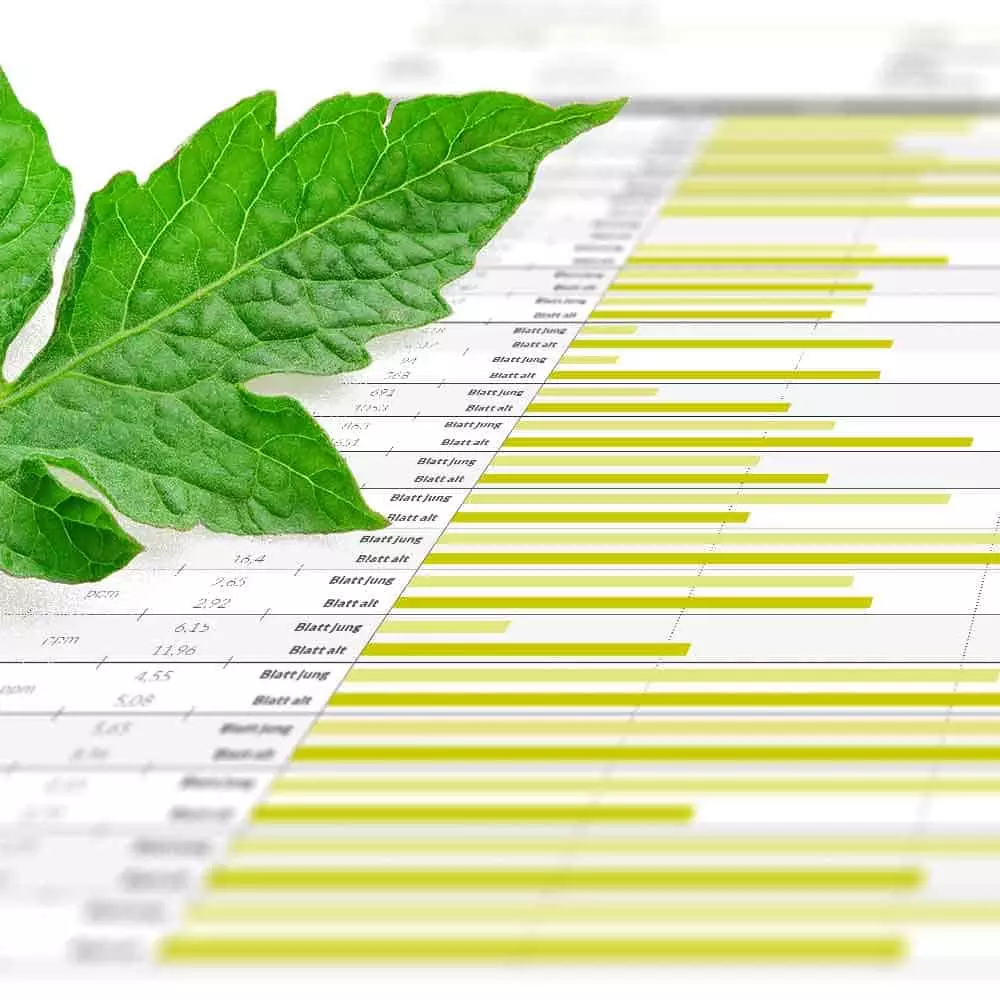
Leaf sap analysis shows the current nutrient supply in the plant. It reveals nutrient excesses and deficiencies before symptoms can be observed. Optimal nutrient uptake is central to healthy and resilient plants and improves the quality and shelf life of the final products.
Proactive nutrient management for more efficient fertilizer use
If nutrient deficiencies become visible, problems in plant nutrition are already well advanced. The consequences are reduced yield and/or increased susceptibility to pests and diseases.
Plant sap analysis determines the nutrient content of the plants and reveals nutrient deficiencies and excesses before they cause damage. It enables proactive nutrient management – fertilization can be quickly and individually adapted to the crop. Using this innovative method, nutrient mobility can be tracked over time – providing valuable information that enables fast and data-driven management decisions.
Advantages of leaf sap analysis

Crops
If the crop to be examined is not listed, please contact us.
Targeted fertilization with leaf fertilizer

Citric acid – 25 kg
Citric acid lowers the pH of your spray water and dissolves limescale in drip irrigation lines. One 25 kg bag makes 37.5 litres of 50 % solution, as strong as liquid citric acid from the trade.
Citric acid monohydrate (E 330), food grade, purity at least 99.5 %. For acidifying spray mixes, descaling drip and irrigation systems, removing lime deposits from leaves and as a chelating agent in foliar fertiliser solutions.
Contents: 25 kg bag


Kristallkalk sun protection – 25 kg
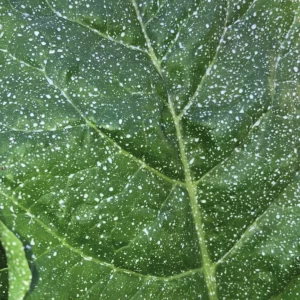
Kristallkalk keeps leaves cooler on hot days. The white film of fine lime crystals reflects part of the sunlight: in sugar beet, Bodenversum measured an average leaf temperature of 29.1 instead of 32.2 °C.
This does not slow down photosynthesis. On a hot summer day the leaf has more light than it can use; what holds it back is the heat. In every trial Bodenversum has shown us, the yield with Kristallkalk was above the untreated control.
Suitable for sugar beet, potatoes, cereals, vegetables, vines and fruit, and as a trunk coating. The needle-shaped crystals stick to the leaf better than ground limestone. Every application also brings calcium onto the leaf: 39 % Ca as calcium carbonate.
Apply with a crop sprayer: 6–10 kg/ha depending on water volume, 2–8 applications per season, no waiting period before harvest.
Contents: 25 kg bag
On request: pallet of 42 bags, 1050 kg




NK foliar fertiliser PhytoGreen Organic NK 4-6 10 litres
Nitrogen and potassium from sugar beet vinasse — 4 % N, of which 3.6 % is organically bound and of plant origin, plus 6 % water-soluble K2O.
Listed on the FiBL input list for organic farming in Switzerland.
The nitrogen comes as protein and amino acids, not as a salt. Soil microbes mineralise it, so it is released more slowly than from a mineral fertiliser. The C/N ratio of 6.5 is narrow enough to avoid nitrogen lock-up — and the 26 % organic carbon feeds the soil life at the same time.
Via irrigation at max. 5 %, via the leaf at 0.4–1.5 %. Foliar application can leave spray marks — so do not apply to russeting-prone pome fruit varieties or during flowering.
Content: 10 litres (13.0 kg)
200 litres CHF 347.85 and 1000 litres CHF 1’097.85 — not in stock, delivery on request

Organic Liquid Calcium 10 liters
Liquid calcium fertilizer, 8.0% CaO (water-soluble calcium oxide) for rapid uptake via the leaf. To improve assimilation performance, for higher yields: 4–8 l/ha or
2% w/v (2 l/100 l water) for foliar sprays.
The application of Bio NPK 2-1-10 can be combined with other foliar fertilizers and compost tea. (except sulfur and magnesium sulfate)
Listed as an input by the Research Institute of Organic Agriculture (FiBL).

PhytoGreen® – Organic NPK 2-1-10
Organic NPK fertilizer, liquid, with a high potassium content from purely plant-based raw materials. Through fermentation and enzymatic hydrolysis, a high-quality, potassium-focused complete fertilizer is created, which also provides water-soluble trace elements. Suitable for the fruiting phase of the crop.
The application of Organic NPK 2-1-10 can be combined with other foliar fertilizers and compost tea.
Listed as an operating material by the Research Institute of Organic Agriculture (FiBL).
Content: 10 liters
On request: 200 liters, 1000 liters


Round hole bayonet nut for flat fan nozzle FT 140-06, incl. gasket
The FT nozzles are round, so you may need a different bayonet nut than the one you have used previously.
(For TR, ITR, FT BN hose nipple) Nozzle cap (including gasket) from Lechler TWISTLOC system, suitable for FT flat fan nozzles (FT-140) or also TR hollow cone nozzles, ITR injector nozzles and other nozzles with round hole caps. Color: Black. Hole diameter: 12.65 mm.
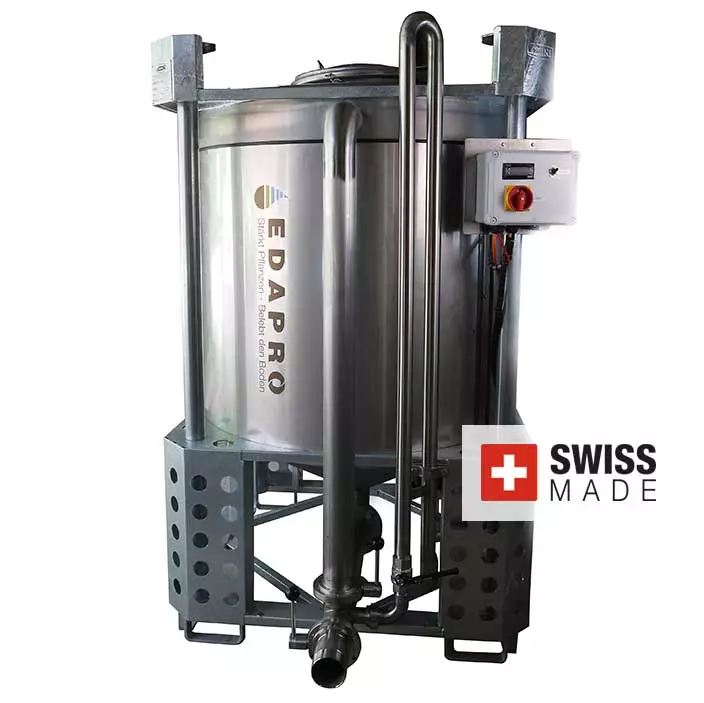

EdaLife Chrome compost tea brewing system
The flagship of our brewers. The Chrome compost tea brewer offers the highest quality without compromise, made from stainless steel.
One device – three applications
The brewer is not only excellent for producing compost tea, but also for making compost extract and ferments (EM).
V500 and V900: optional with integrated heating, heating control and insulation – required for producing ferments.
V500 and V900: made in Switzerland.
New: EdaLife V1500
The large stainless steel brewer: 1,500 litres of compost tea per batch, enough for 10 to 20 hectares. Available without heating only. Made in Holland to EDAPRO’s Swiss design. Delivery time: 2 months.
Additional Information
| Weight | 0.2 kg |
|---|---|
| Analyses | 1, 2, 3, 4, 5, 6, 7, 8, 9, 10, 11, 12, 13, 14, 15, 16, 17, 18, 19, 20 |
| Number of shipping dates | without pre-paid shipping documents for shipping to the laboratory in the Netherlands, 1, 2, 3 |


